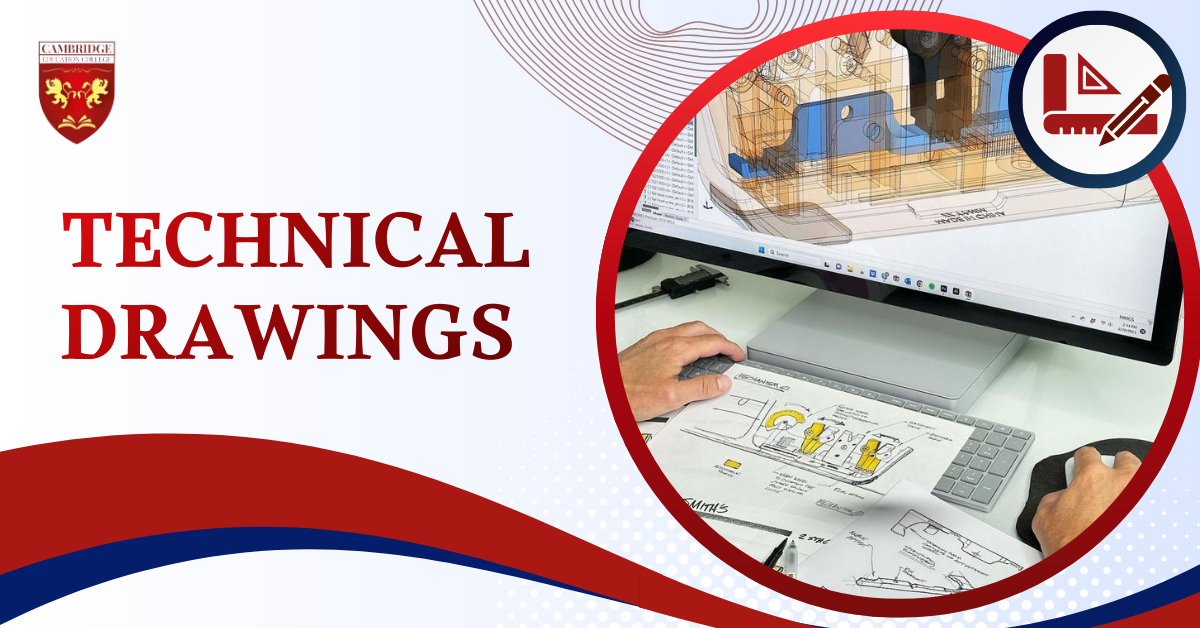
The Technical and Engineering Drawing programme is a comprehensive educational course designed to develop both fundamental and advanced skills in technical drawing. It begins with basic principles such as line drawing and gradually progresses to mastering sections, geometric details, and understanding the relationship between projection and perspective. The programme combines theoretical knowledge with practical application, enabling participants to produce precise technical drawings used in industrial design, engineering, architecture, and manufacturing.
🎯 Key Concepts:
Establishing foundational concepts and tools in technical drawing.
Learning geometric construction, projection, and perspective techniques.
Developing the ability to read and produce professional technical drawings.
Applying drawing methods to accurately communicate ideas and designs.
Understanding scale, detail, and sectioning for professional project presentation.
✅ Expected Outcomes
By the end of the programme, learners will be capable of producing accurate technical drawings using appropriate tools and methods. They will gain the ability to prepare professional engineering illustrations, interpret technical plans, and convert three-dimensional concepts into detailed two-dimensional representations, enhancing their opportunities in design, engineering, and architecture fields.
👥 Target Audience:
Engineering and technical institute students
Individuals interested in industrial or architectural design
Beginners in the field of technical drawing
Trainers and technicians in the construction sector
Enthusiasts of 3D design and modelling
Learn the essential principles and tools of technical drawing and build foundational drafting skills.
Lesson 1: Introduction to Technical Drawing
Lesson 2: Gathering the Required Drawing Tools
Lesson 3: Starting with Lines
Lesson 4: The Evolution of Technical Drawing
Lesson 5: The Title Block in Technical Drawings
Lesson 6: Creative Use of Geometric Shapes
Lesson 7: Techniques of Geometric Construction
Lesson 8: Basics of Annotation and Technical Labelling
Develop advanced drafting techniques including projection, perspective, and technical sectioning using precise measurements.
Lesson 1: Basic Concepts of Loci in Geometry
Lesson 2: Fundamentals of Projection Drawing
Lesson 3: Introduction to Perspective Drawing
Lesson 4: Developing and Drawing Surfaces
Lesson 5: The Blueprint: Technical Drawing for Execution
Lesson 6: Architectural Elevation Drawing
Lesson 7: Sectional Drawing Techniques
Lesson 8: Mastering Scale and Measurement in Technical Drawings
Students receive an accredited certificate issued by Cambridge British College.
Yes, all certificates issued by the college are accredited by the relevant official authorities.
Yes, after completing the course, you may contact the Admissions and Registration Department to obtain an electronic copy.
You can register online through the website by visiting the Admissions and Registration page and completing the payment electronically.
Applicants must be at least 16 years old or hold a secondary school certificate (or equivalent) for certain programmes.
Yes, you may enrol in multiple courses simultaneously.
All courses are offered online.
The duration varies depending on the programme and generally ranges from one to six months.
Yes, assessment is based on participation, assignments, and final examinations depending on the nature of the course.
Yes, you can retake the course in the next session at a reduced re-enrolment fee.
Fees vary according to the course and number of study hours. Full details are available on each course page.
Payments can be made online via the college’s secure electronic payment link.
Yes, instalment plans are available for selected courses under specific conditions.
No, course fees are non-refundable according to the college’s refund policy.
You can reach us via the official email address or by phone.
Yes, a dedicated technical support team is available to assist with any platform-related issues.
You can schedule an appointment with an academic adviser by contacting the guidance team.
Some courses include practical training or partnerships with employers to provide internship and job opportunities.

 Welcome to Cambridge Education College
 Programs